Monday, 30 July 2018

DATA INTERPRETATION


Direction:- 

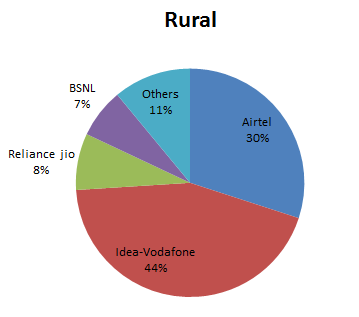
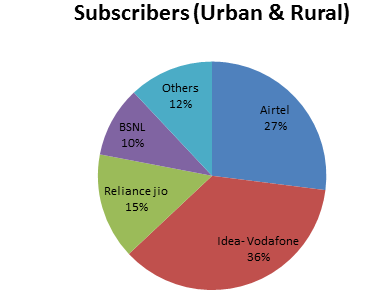
The Telecom Regulatory Authority of India ( TRAI ) gives his report on mobile subscribers in India. These subscribers use different telecom operators. The data is given in pie chart given below. Study the chart carefully and understand it and answer the questions based on it.
Total no of Subscribers (Urban and Rural) = 1200 million
Data Interpretation Quiz For SBI PO 2018
Total no of Rural subscriber= 500 million

Data Interpretation Quiz For SBI PO 2018

Question 1:

What is the difference between number of Idea-Vodafone subscribers from rural area and number of Airtel subscribers from Urban area. 1. 44 mm 2. 70 mm 3. 54 mm 4. 46 mm 5. N.O.T.

Solution – 

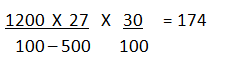
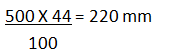
Idea-voda subscribers from rural = Data Interpretation Quiz For SBI PO 2018
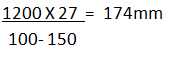
No of Airtel subscribers from urban =
  Data Interpretation Quiz For SBI PO 2018
Hence difference = 220- 174 = 46mm
Option 4 is correct

Question 2:

The number of Idea-Vodafone subscribers from urban areas is what percent more or less than the number of Airtel & BSNL subscribers together from rural area. 1. 18% 2. 15.5% 3. 14.6% 4. 17% 5. 19%

Solution- 

Idea-Voda subscribers from urban= Data Interpretation Quiz For SBI PO 2018
Airtel & BSNL subscribers together from rural area =
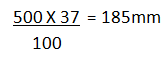
Data Interpretation Quiz For SBI PO 2018
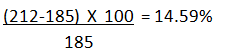
Percentage % =
Data Interpretation Quiz For SBI PO 2018
So option 3 is correct.

Question 3:

What is the average number of subscribers of Airtel, Idea-vodafone, Jio and BSNL from urban areas? 1. 155.50 2. 151.25 3. 152.75 4. 150 5. 153.25

Solution- 

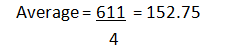
number of subscribers of Airtel, Idea-Vodafone , Jio and BSNL from urban areas. Data Interpretation Quiz For SBI PO 2018

Data Interpretation Quiz For SBI PO 2018
So option no 3 is correct.

Question 4:

What is the ratio of no of subscribers of Airtel in Rural areas to no of subscribers in urban areas. 1. 87 : 75 2. 75 : 87 3. 25 : 54 4. 54 : 25 5. N.O.T.

Solution- 

rural Airtel subscribers= Data Interpretation Quiz For SBI PO 2018
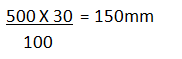
Urban Airtel subscribers=
Data Interpretation Quiz For SBI PO 2018
Therefore ratio= 150 : 174 =75 :87
Hence option no 2 is correct.


Question 5:

If 10% of Airtel subscribers , 6% of Idea-Vodafone subscribers and 15% of BSNL subscribers of urban areas are changed to reliance jio , so What is the percentage increase in jio subscriber in urban areas. 1. 19% 2. 23.5% 3. 18.5% 4. 21.5% 5. N.O.T.

Solution-

total no of airtel subscribers in urban areas=
Data Interpretation Quiz For SBI PO 2018
10% of 174= 17.4
total no of idea-vodafone subscribers in urban areas=

6% of 212= 12.72
total no of jio subscribers in urban areas initial=
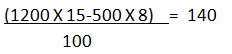
Data Interpretation Quiz For SBI PO 2018

final jio subscribers =140+17.4+12.72= 170.12 mm
hence % increase =
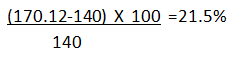
Data Interpretation Quiz For SBI PO 2018

SWACHH SURVEKSHAN 2018

Highlights of the survey:

  • Name of the survey-Swachh Survekshan-2018
  • Announced by- Ministry of Housing and Urban Affairs
  • Number of Municipalities covered-4,203
  • Cleanest city in India-Indore
  • Best Performing state-Jharkhand
  • Cleanest city among municipal bodies-New Delhi
  • Cleanest among all state capitals-Mumbai


Swachh Survekshan 2018

  • Swachh Survekshan 2018, which was the first pan Indian exercise to assess cleanliness in urban India, surveyed 4,203 cities from January 4 to March 10, 2018.
  • In the Swachh Survekshan-2018, total 37.66 lakh citizens gave their feedback, which covered 4,203 municipal areas across the country
Swachh Survekshan-2018

The Per Capita investment on waste management is very high for all big cities that top Swachh Survekshan list. Our Corporations cannot afford that.-- By Dr R.Ajayakumar Varma(Executive Director, Suchitwa Mssion )


How the survey is conducted?

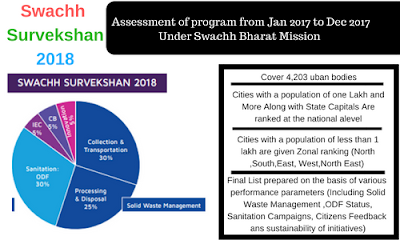
Under this survey, cities will be ranked based on 71 sanitation related parameters with different weightages for a total of 4,000 marks. Total score has been doubled this time to avoid crowding of cities with very marginal differences in scores that happened in the previous survey.


Sanitation component-wise weightages:    

Component
Weightages in
 2018 Survey
Weightages in
2017 Survey
ODF progress
30 %
30 %
Collection & Transportation of
SolidWaste

30 %

40 %
Processing & disposal
of solid waste

25%

20%
Information, Education,
Communication

5%

5%
Capacity Building
5%
5%
Innovation
5%
-
 

 Assessment Weightages:


Assessment category
Weightages in
2018  Survey
Weightages in
2017  Survey
Service level progress
(Infrastructure creation,
 processes, operations)

35%

45%
Citizen feedback
30%
25%
Independent field observation
25%
30%


Key Outcomes in the survey:

  • Indore in Madhya Pradesh is emerged as cleanest city in India
  • Bhopal and Chandigarh has been ranked as second and third cleanest cities in India
  • Among municipal bodies with less than three lakh population New Delhi Municipal Council (NDMC) emerged as the cleanest city
  • Greater Mumbai was found to be the cleanest among all state capitals.
  • Vijayawada is cleanest among big cities having more than one million population
  • Mysuru has emerged as the cleanest among cities with population of three lakh to one million.


Other important points:

  • Cleanest City (Population >10 lakh): Vijayawada, Andhra Pradesh
  • Cleanest City (Population 3-10 lakh): Mysuru, Karnataka
  • Cleanest City (Population 1-3 lakh): NDMC (New Delhi Municipal Council)
  • Best city in Innovation and Best practices: Nagpur
  • Best city in Solid Waste Management: Navi Mumbai


India’s Cleanest City Zone-Wise:

  • North: Bhalso, Punjab
  • East: Bundu, Jharkhand
  • North-East: Kakching, Manipur
  • South: Siddipet, Telangana
  • West: Panchgani, Maharashtra


Model Questions:


Question 1:

Which of the following ministry organized Swachh Survekshan 2018?
a. Ministry of Housing and Urban Affairs
b. Ministry of rural development
c. Ministry of Drinking Water and Sanitation
d. None of the above

Ans: a

Question 2:

As per Swachh Survekshan-2018 which state has been declared the best-performing state?
a. Madhya Pradesh
b. Jharkhand
c. Maharashtra
d. Andhra Pradesh

Ans: b

Solution: Jharkhand has been declared the best-performing state, followed by Maharashtra, in this year's Swachh Survekshan.


Question 3:

Which of the following is not correct with respect to Swachh Survekshan-2018?
a. It is evaluated on six parameters Collection and transportation of municipal solid waste (30 percent) Processing and disposal of solid waste (25%) IEC (Information, Education and Communication) (5%), Capacity building (5%), Innovation and best practices (5 %)
b. Mumbai has bagged the tag of the cleanest state capital in India in the Swachh Survekshan (cleanliness survey) 2018
c. The survey assessed sanitation in all 4,041 cities and towns of the country.
d. All are correct

Ans: d

Question 4:

Which of the following city emerged as cleanest among big cities having more than one million population?
a. Vizag
b. Vijayawada
c. Tirupathi
d. Kurnool

Ans: b

Solution: Vijayawada is cleanest among big cities having more than one million population while Mysuru has emerged as the cleanest among cities with pollution of three lakh to one million.

SAMARTH SCHEME - 2018

Introduction
        Today, we will be discussing a scheme related to the textile sector under the Skill India Mission which was in news i.e. SAMARTH SCHEME. Lately a meeting was held by our Union Textile Minister, Smriti Zubin Irani along with the Minister of state for Textiles,Mr. Ajay Tamta and
Secretary(Textiles),Mr.Anant Kumar Singh, in the capital city of Delhi to apprise its shareholders about the scheme and its guidelines.
  • The stakeholders concerned, were encouraged to give their feedback while also addressing their concerns,vis-a-vis to the implementation of the SAMARTH scheme. 
  • The guidelines of the scheme got released on 23rd April,2018 so as to facilitate its stakeholders in addressing their issues related to its workings at the ground level.

What the Scheme Is all about?
  • Well, SAMARTH- Scheme for capacity building in Textile Sector, got launched by the Ministry of Textiles for the training and employability of the youth in the booming textile sector of India. 
  • It has been envisaged to provide skill development training to around 10 lakh youth(9 lakh in the organised and 1 lakh in the traditional textile sector)over a period of 3 years(2017-2020) with an outlay of 1300 crore Rupees, so as to achieve the governments vision of increasing India’s textile export to 300 billion USD by 2025.
  • This scheme was approved by the CCEA on 20th December,2017 and got launched under the leadership of Shree Narendra Modi.

Highlights-
  • To Train 10 lakh youth pan India for the textile sector over a duration of 3 years i.e(2017-2020)
  • A sum of 1300 Crore Rupees have been allotted for it.
  • Ministry of Textiles is the Nodal Agency.
  • Training courses to be compliant with the National Skill Qualification Framework(NSQF).
  • Textile Committee to work as Resource Support Agency(RSE)
  • To use Biometric identification process for the selection of the candidates for the training purposes,thus AADHAAR is mandatorily required.
  • To provide real time attendance system to be integrated with the centralized Management Information System(MIS).
  • It covers the entire value chain of textiles,except the spinning and weaving industry.
  • To achieve the Government Of India’s target of increasing India’s export target of 300 billion USD by the year 2025.
  • To ensure 70% placement, on the successful completion of the scheme in the textile and allied sectors.
  • Training to be funded by the Ministry of Skill Development and Entrepreneurship(MSDE).
  • RSE-Resource Support Agency, has been entrusted with the development of the course content, specifying the training centres infrastructural requirements, standardizing the admission assessment certification and accreditation processes.
  • Textile committee also needs to train and conduct regular assessment tests for their trainers.

NSQF-National Skills Qualifications Framework-
  • The NSQF is required at the National Skill Development Agency (NSDA) and is being brought into force through the National Skills Qualifications Committee (NSQC) which comprises of all the concerned stakeholders.
  •  The NSQF is a mechanism which rates the skills,aptitude and the level of knowledge possessed by an individual, on a scale of 1 to 10,and are expressed in terms of the learning outcomes which a learner must have, in order to successfully complete the course and acquire the necessary competencies in the area of his interest or work. 
  • In India it was notified in the year 2013,following suit the major developed or developing countries.
It has to be seen how successfully, SAMARTH Scheme gets implemented, in the near future and, to what extent it is able to achieve its targets as envisioned by the Government of India and the Ministry of Textiles.

Related Posts Plugin for WordPress, Blogger...