Showing posts with label ENVIRONMENT. Show all posts

Wednesday, 22 January 2020

FOREST FIRE

            The  word “fire”  evolved from the  Greek word “pyra” meaning growing  embers. Fire is actually the heat  and the light that results when three  elements i.e. fuel, oxygen and the source  are combined. The other elements, which determine  the behavior of the fire, are weather, the landscape  and the presence of the fuel.
            Recent forest fire in Australia has been alarmed the world, this can be understood, need urgent measures in combating forest fire  which highly impacted the ecosystem. Let us see how India prepared forest fire.

 Why forests fire?
            Forest  fire may  be defined  as an unclosed  and freely spreading combustion  that consumes the natural fuels.  Combustion. More than ninety five percent  forest fires are caused either by negligence or unknowingly by the human being. The rest of the fires are caused by natural reasons i. e. lightning, extreme rise in the temperature etc., which are very rare. In general all over the world the main causes  of forest fires are anthropogenic. According to FAO report “Fire Management- Global Assessment ”, regional estimates of human induced forest fires as follows:
a. Mediterranean- 95%
b. South Asia 90 %
c. South America 85
d. North America 80 %
e. Balkan countries 59 %

The natural causes of forest fires are common in remote areas only.

.

.
Causes of forest Fire :
.

.
Adverse impacts of forest fire:
·       Forest fires are a major cause of degradation of forests/environment.
·       Loss of valuable timber resourcesForest fires cause indispensable loss to timber and deteriorate its quality. Valuable timber species like teak, sal, chir, deodar, sheesam , rosewood etc. are adversely affected by fire.
·       Impact of forest fire on eco- system:The uncontrolled fires in such areas help in spreading pine forest at the cost of indigenous oak forest, which is very serious threat to the ecological balance.
·       Degradationofwatercatchmentsareasresultingintolossofwater-After forest fire, soil moisture is decreased and litter decomposition becomes almost negligible, which creates a possibility of forest fire in future.
·       Loss of wildlife habitat and depletion of wildlife- Forests are the habitat of many wild animals.Forest fire dramatically impacts the animal.
·       Loss of natural vegetation and reduction of forest cover- As a result of fires, millions of hectares of the forest area turn to ashes and remains of no use.
·       Global warming- One of the major culprits of climate change is forest fire. The immediate effect of vegetation burning is the production and release of gases including carbon dioxide, carbon monoxide, methane, non-methane hydrocarbons, nitric oxide, methyl chloride and various other gases, which are released and returned to the atmosphere in a matter of hours.

·       Socio-economic impact- Fire is a major factor of destruction of human settlement and often causes deterioration of site by subsequent increased erosion.
.

.
            The Government of India took numbers of the progressive steps for protection, preservation and management of forests fires, including:
I. The Indian Forest Service was revived in 1966 to ensure co-ordinated professional management of Forests.
2. government initiated National plan forest fire management. :considers Forest Fire Management as an integral component of forest management planning,
3.Since the year 2005, FSI has been monitoring forest fires across the country using inputs received from MODIS satellite system, a joint collaboration of NASA.
4.Institutional Setup for Forest Fire Management and stakeholders coordination. example :the Forest Protection Division, headed by Inspector General (IG) level officer looks after the forest fire management work at National level with the cooperation of National Disaster Management Authority (NDMA).
5:Policy framework :Develop/ update forest fire manuals for field staff guiding them in simple way to detect/ report about and suppress forest fire.
6. Assess and monitor forest fire risks and enhance sustainable application of warning systems :Increased capacity in generating relevant warning, increased understanding of warning systems by forest management functionaries and sustained support and coordination between the partner organizations
7 Knowledge management, capacity building and awareness generation:Use knowledge and training to build a culture of innovation, safety and resilience, and institutionalize training on FFM for Forest Department, other role players and also at community levels.Example:Central Fire Management Research and Training Institute.
8 Technical options for forest fire management:Increased capacity to manage forest fire, involving community and using a variety of tested technical interventions.


Systematic Strategic planning effective forest management :
·       Publicity and extension- Covering preparation of publication/extension material e.g. pamphlets, handouts, circulars, posters and media programs through TV, radio, video tapes, etc.
·       Training and education- Designing syllabus for planning, management and ground level firefighting courses in Forestry Institutions.
·       Strengthening of organizational framework- Though appropriate modification and alteration in State Forest Departments’ structural framework and providing sufficient human power.
·       Research and development, by strengthening the existing and introducing new R&D institutions dealing with forest fire management.
·       Establishment of National Forest Fire Danger Rating System- Designing uniform.

·       Contious Monitoring,  evaluation and updating  prescription- Designing uniform formats for reporting, monitoring and evaluation.


ENVIRONMENT AND ECOLOGY BY MAJID HUSSAIN


.
.


.
.


Wednesday, 18 December 2019

NATIONAL BIODIVERSITY AUTHORITY

The Convention on Biological Diversity (CBD) was signed by the Community and all the Member States at the United Nations Conference on Environment and Development in Rio de Janeiro from 3 to 14 June 1992, and come into effect in 29th December 1993. It is an international legally binding treaty. The Convention has three main goals:
§ conservation of biological diversity
§ sustainable use of its components
§ fair and equitable sharing of benefits arising from genetic resources
For realizing the objectives of CBD, Government of India enacted an umbrella legislation called the biological Diversity Act 2002 aimed at conservation of biological resources and associated knowledge as well as facilitating access to them in a sustainable manner and through a just process.
§ To implement this Act central government established a body called as National Biodiversity Authority, under the power conferred by section 8 of CBD Act. It started functioning from 1st October 2003. The NBA is an Autonomous body .The main functions of the Authority are, according to Ministry of environment and forest.
§ It shall be the duty of the National Biodiversity Authority to regulate activities referred to in sections 3, 4 and 6 and by regulations issue guidelines for access to biological resources and for fair and equitable benefit sharing.
§ The National Biodiversity Authority may grant approval for undertaking any activity referred to in sections 3, 4 and 6.
§ The National Biodiversity Authority may advise the Central Government on matters relating to the conservation of biodiversity, sustainable use of its components and equitable sharing of benefits arising out of the utilization of biological resources;
§ The National Biodiversity Authority may advise the State Governments in the selection of areas of biodiversity importance to be notified under sub‑section (1) of section 37 as heritage sites and measures for the management of such heritage sites;
§ The National Biodiversity Authority may perform such other functions as may be necessary to carry out the provisions of this Act.

§ The National Biodiversity Authority may, on behalf of the Central Government, take any measures necessary to oppose the grant of intellectual property rights in any country outside India on any biological resource obtained from India or knowledge associated with such biological resource which is derived from India.
.

.

It is a 3 tier system

1.              At national Level: National Biodiversity Authority (NBA)
2.              At State Level: State Biodiversity Boards (SBB’s) – Advise the State Governments, subject to guidelines issued by the Central Government, on matters relating to conservation of biodiversity, sustainable use of its components and equitable sharing of benefits arising out of utilization of biological resources.
3.              On local Level: Biodiversity Management Committees (BMC’s) – Prepare, maintain and validate People’s Biodiversity Register (PBR) in consultation with the local people. T Advice on any matter referred to it by the State Biodiversity Board or Authority for granting approval.
Currently there are  SBBs in 26 States, and around 33,426 BMCs. BMC’s can be a major tool for implementation this whole system but actually it is not working. There are not all areas of country which have proper BMC’s working there and this register maintenance is these days is just a matter of formality. Current chairman of authority is Dr. Balakrishna Pisupati , and office is situated at Chennai.


(Sources: National Biodiversity Authority, MEOF )
.

.


Friday, 20 July 2018

7 MAJOR ENVIRONMENTAL MOVEMENTS IN INDIA

        The contemporary India experiences an almost unrestricted exploitation of resources because of the lure of new consumerist lifestyles. The balance of nature is disrupted. This has led to many conflicts in the society. In this article, we discuss the major environmental movements in India.

Environmental Movements in India 

What is an Environmental Movement?

  • An environmental movement can be defined as a social or political movement, for the conservation of environment or for the improvement of the state of the environment. The terms ‘green movement’ or ‘conservation movement’ are alternatively used to denote the same.
  • The environmental movements favour the sustainable management of natural resources. The movements often stress the protection of the environment via changes in public policy. Many movements are centred on ecology, health and human rights.
  • Environmental movements range from the highly organized and formally institutionalized ones to the radically informal activities.
  • The spatial scope of various environmental movements ranges from being local to the almost global.

Major Environmental Movements in India

Some of the major environmental movements in India during the period 1700 to 2000 are the following.


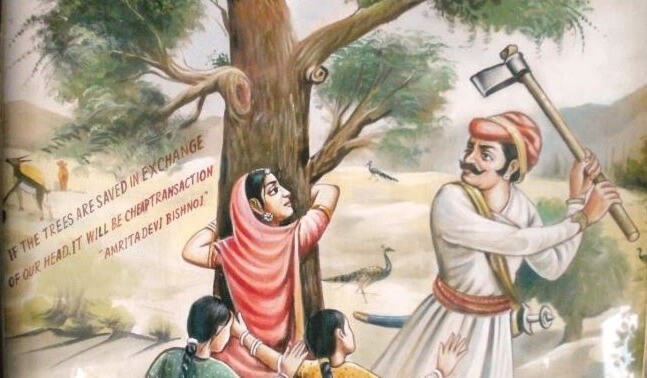
1.Bishnoi Movement

Bishnoi Movement
  • Year: 1700s
  • Place: Khejarli, Marwar region, Rajasthan state.
  • Leaders: Amrita Devi along with Bishnoi villagers in Khejarli and surrounding villages.
  • Aim: Save sacred trees from being cut down by the king’s soldiers for a new palace.
What was it all about: Amrita Devi, a female villager could not bear to witness the destruction of both her faith and the village’s sacred trees. She hugged the trees and encouraged others to do the same. 363 Bishnoi villagers were killed in this movement. The Bishnoi tree martyrs were influenced by the teachings of Guru Maharaj Jambaji, who founded the Bishnoi faith in 1485 and set forth principles forbidding harm to trees and animals. The king who came to know about these events rushed to the village and apologized, ordering the soldiers to cease logging operations. Soon afterwards, the maharajah designated the Bishnoi state as a protected area, forbidding harm to trees and animals. This legislation still exists today in the region.


2. Chipko Movement

Chipko Movement
  • Year: 1973
  • Place: In Chamoli district and later at Tehri-Garhwal district of Uttarakhand.
  • Leaders: Sundarlal Bahuguna, Gaura Devi, Sudesha Devi, Bachni Devi, Chandi Prasad Bhatt, Govind Singh Rawat, Dhoom Singh Negi, Shamsher Singh Bisht and Ghanasyam Raturi.
  • Aim: The main objective was to protect the trees on the Himalayan slopes from the axes of contractors of the forest.
What was it all about: Mr. Bahuguna enlightened the villagers by conveying the importance of trees in the environment which checks the erosion of soil, cause rains and provides pure air. The women of Advani village of Tehri-Garhwal tied the sacred thread around trunks of trees and they hugged the trees, hence it was called ‘Chipko Movement’ or ‘hug the tree movement’. The main demand of the people in these protests was that the benefits of the forests (especially the right to fodder) should go to local people. The Chipko movement gathered momentum in 1978 when the women faced police firings and other tortures. The then state Chief Minister, Hemwati Nandan Bahuguna set up a committee to look into the matter, which eventually ruled in favor of the villagers. This became a turning point in the history of eco-development struggles in the region and around the world.


3. Save Silent Valley Movement

Silent Valley
  • Year: 1978
  • Place: Silent Valley, an evergreen tropical forest in the Palakkad district of Kerala, India.
  • Leaders: The Kerala Sastra Sahitya Parishad (KSSP) an NGO, and the poet-activist Sughathakumari played an important role in the Silent Valley protests.
  • Aim: In order to protect the Silent Valley, the moist evergreen forest from being destroyed by a hydroelectric project.
What was it all about: The Kerala State Electricity Board (KSEB) proposed a hydroelectric dam across the Kunthipuzha River that runs through Silent Valley. In February 1973, the Planning Commission approved the project at a cost of about Rs 25 crores. Many feared that the project would submerge 8.3 sq km of untouched moist evergreen forest. Several NGOs strongly opposed the project and urged the government to abandon it. In January 1981, bowing to unrelenting public pressure, Indira Gandhi declared that Silent Valley will be protected. In June 1983 the Center re-examined the issue through a commission chaired by Prof. M.G.K. Menon. In November 1983 the Silent Valley Hydroelectric Project was called off. In 1985, Prime Minister Rajiv Gandhi formally inaugurated the Silent Valley National Park.


4. Jungle Bachao Andholan

Jungle Bachao Andolan
  • Year: 1982
  • Place: Singhbhum district of Bihar
  • Leaders: The tribals of Singhbhum.
  • Aim: Against governments decision to replace the natural sal forest with Teak.
What was it all about: The tribals of Singhbhum district of Bihar started the protest when the government decided to replace the natural sal forests with the highly-priced teak. This move was called by many as “Greed Game Political Populism”. Later this movement spread to Jharkhand and Orissa.


5. Appiko Movement

Appiko Movement
  • Year: 1983
  • Place: Uttara Kannada and Shimoga districts  of Karnataka State
  • Leaders: Appiko’s greatest strengths lie in it being neither driven by a personality nor having been formally institutionalised. However, it does have a facilitator in Pandurang Hegde. He helped launch the movement in 1983.
  • Aim: Against the felling and commercialization of natural forest and the ruin of ancient livelihood.
What was it all about: It can be said that Appiko movement is the southern version of the Chipko movement. The Appiko Movement was locally known as “Appiko Chaluvali”. The locals embraced the trees which were to be cut by contractors of the forest department. The Appiko movement used various techniques to raise awareness such as foot marches in the interior forest, slide shows, folk dances, street plays etc. The second area of the movement’s work was to promote afforestation on denuded lands. The movement later focused on the rational use of ecosphere through introducing alternative energy resourceto reducece pressure on the forest. The movement became a success. The current status of the project is – stopped.


6. Narmada Bachao Andholan (NBA)

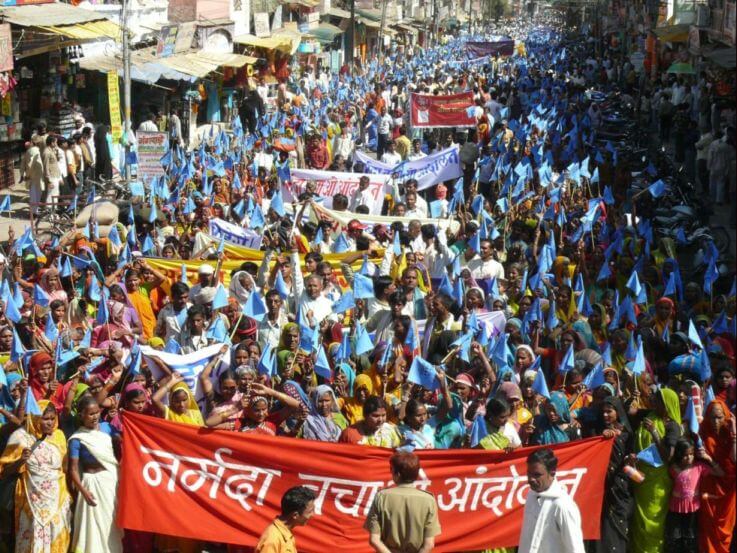
Narmada Bachao Andholan
  • Year: 1985
  • Place: Narmada River, which flows through the states of Gujarat, Madhya Pradesh and Maharashtra.
  • Leaders: Medha Patker, Baba Amte, adivasis, farmers, environmentalists and human rights activists.
  • Aim: A social movement against a number of large dams being built across the Narmada River.
What was it all about: The movement first started as a protest for not providing proper rehabilitation and resettlement for the people who have been displaced by the construction of Sardar Sarovar Dam. Later on, the movement turned its focus on the preservation of the environment and the eco-systems of the valley. Activists also demanded the height of the dam to be reduced to 88 m from the proposed height of 130m. World Bank withdrew from the project.
The environmental issue was taken into court. In October 2000, the Supreme Court gave a judgment approving the construction of the Sardar Sarovar Dam with a condition that height of the dam could be raised to 90 m. This height is much higher than the 88 m which anti-dam activists demanded, but it is definitely lower than the proposed height of 130 m. The project is now largely financed by the state governments and market borrowings. The project is expected to be fully com­pleted by 2025.
Although not successful, as the dam could not be prevented, the NBA has created an anti-big dam opinion in India and outside. It questioned the paradigm of development. As a democratic movement, it followed the Gandhian way 100 per cent.


7. Tehri Dam Conflict

Tehri Dam
  • Year: 1990’s
  • Place: Bhagirathi River near Tehri in Uttarakhand.
  • Leaders: Sundarlal Bahuguna
  • Aim: The protest was against the displacement of town inhabitants and environmental consequence of the weak ecosystem.
Tehri dam attracted national attention in the 1980s and the 1990s.  The major objections include, seismic sensitivity of the region, submergence of forest areas along with Tehri town etc. Despite the support from other prominent leaders like Sunderlal Bahuguna, the movement has failed to gather enough popular support at national as well as international levels.

Wednesday, 29 March 2017

Understanding EL NINO AND LA NINA Phenomena and Their Implication on India

Introduction
        Monsoon is a familiar though a little known climatic phenomenon. In India, from agriculture to economic policies to disaster management, a lot depends on the Monsoon.
        The Monsoon is a recurring event i.e. it repeats after a certain frequency of time – a year in our case. But, it may not be uniform in every period (year). There are a lot of factors which affect its duration and intensity over India.
         The Monsoon is basically a result of the flow of moisture laden winds because of the variation of temperature across the Indian Ocean.
        There are a number of climatic phenomena which affect it namely the Indian ocean dipole, El nino, La nina, Equatorial Indian Ocean Oscillation (EQUINOO) etc. These phenomena affect the temperature distribution over the oceans and thus affecting the direction and intensity of flow of the moisture laden winds.
        There have been recent reports that El Nino may disturb the Indian Monsoon and play badly with Indian agriculture. This brings us to the discussion of the concepts of El Nino and La Nina. In what follows we will look at their origin, mechanism, impact and mitigation strategies. We need not go into trivial details but only understand them from exam point of view.

Origin

          El Nino and La Nina are opposite phases of what is known as the El Niño-Southern Oscillation (ENSO) cycle. The ENSO cycle is a scientific term that describes the fluctuations in temperature between the ocean and atmosphere in the east-central
Equatorial Pacific
. (The area between South America and Australia near the equator – look at the diagram)
 
La Nina is sometimes referred to as the cold phase of ENSO and El Nino as the warm phase of ENSO. These deviations from normal surface temperatures can have large-scale impacts not only on ocean processes, but also on global weather and climate, including India.

  Mechanism

       NOW, it is important to understand how these phenomena affect the Monsoon system? To know this, we must first know the pressure and temperature distribution in the region before their onset. (We are assuming here that you are a little bit familiar with the phenomenon of Monsoon.)
For a normal monsoon season, the pressure distribution is as such:
1.     The Peruvian coast has relatively high pressure than the areas near north Australia and South-East Asia.
2.     The Indian Ocean is slightly warmer than the adjoining oceans (West pacific –see diagram) and thus the pressure is low relatively due to the warm seas. This is why the moisture laden winds move from near the west pacific to the Indian Ocean and from there on to the lands.
3.     The pressure on heated Indian land is much lower than that on the Indian Ocean.

        This facilitates the movement of monsoon winds from the sea to the Indian land without any significant diversion.
         But if for some reason this normal distribution is affected, then there is a change in the way trade winds (or monsoon winds) would blow.
       However, the following is the pressure and temperature distribution in an El-Nino situation.
        La Nina is sometimes referred to as the cold phase of ENSO and El Nino as the warm phase of ENSO. These deviations from normal surface temperatures can have large-scale impacts not only on ocean processes, but also on global weather and climate, including India.

Mechanism
         NOW, it is important to understand how these phenomena affect the Monsoon system? To know this, we must first know the pressure and temperature distribution in the region before their onset. (We are assuming here that you are a little bit familiar with the phenomenon of Monsoon.)
For a normal monsoon season, the pressure distribution is as such:
1.    The Peruvian coast has relatively high pressure than the areas near north Australia and South-East Asia.
2.    The Indian Ocean is slightly warmer than the adjoining oceans (West pacific –see diagram) and thus the pressure is low relatively due to the warm seas. This is why the moisture laden winds move from near the west pacific to the Indian Ocean and from there on to the lands.
3.    The pressure on heated Indian land is much lower than that on the Indian Ocean.

       This facilitates the movement of monsoon winds from the sea to the Indian land without any significant diversion.
        But if for some reason this normal distribution is affected, then there is a change in the way trade winds (or monsoon winds) would blow.
However, the following is the pressure and temperature distribution in an El-Nino situation.
 
This is because of the following reasons (and its effects):

         Off the coast of Peru (read in Eastern Pacific and Central Pacific), there is normally cool surface water because of the cold Peruvian current. But El Niño makes it go warm.
         When the water becomes warm, the tread winds, which otherwise flow from East to west, either reverse their direction or get lost.

            Due to this warm water, the air gets up and surface air pressure above Eastern Pacific gets down. On the other hand, the waters cool off in western pacific and off Asia. This leads to rise in surface pressure over the Indian Ocean, Indonesia, and Australia.
         Now as the pressure over the Peruvian coast reduces because of the warm sea water, the flow of moisture laden winds is directed to the Peruvian coasts from the western pacific (the areas near North Australia and South-east Asia – refer to the diagrams above).
          Hence, the moisture laden winds that should have moved towards the Indian coast now move towards the Peruvian coast.
The warm water causes lots of clouds getting formed in that area, causing heavy rains in Peruvian desert during El Niño years.

         This robs the Indian subcontinent of its share in the Monsoon rains. The greater the temperature and pressure difference, the greater would be the shortage in the rainfall in India.

La-Nina

         La Niña, “anti-El Niño” or simply “a cold event” is the cooling of water in the Eastern Pacific Ocean.

The following happens in La-Nina:
          The water in Eastern Pacific, which is otherwise cool; gets colder than normal. There is no reversal of the trade winds but it causes strong high pressure over the eastern equatorial Pacific.
         On the other hand, low pressure is caused over Western Pacific and Off Asia.

         This has so far caused the following major effects: Drought in Ecuador and Peru. Low temperature, High Pressure in Eastern Pacific.

        Heavy floods in Australia; High Temperature in Western Pacific, Indian Ocean, Off coast Somalia and good rains in India. Drought in East Africa.
         For India, an El Niño is often a cause for concern because of its adverse impact on the south-west monsoon; this happened in 2009. A La Niña, on the other hand, is often beneficial for the monsoon, especially in the latter half. The La Niña that appeared in the Pacific in 2010 probably helped 2010’s south-west monsoon end on a favorable note. However, it also contributed to the deluge in Australia, which resulted in one of that country’s worst natural disasters with large parts of Queensland either under water from floods of unusual proportions or being battered by tropical cyclones.

 Periodicity

         This distortion is pressure and temperature recurs every 4-5 years. But it may not happen exactly after 4-5 years or it may not happen at all. It periodicity is thus quite uncertain.
         El Nino and La Nina episodes typically last nine to 12 months, but some prolonged events may last for years. They often begin to form between June and August, reach peak strength between December and April, and then decay between May and July of the following year. While their periodicity can be quite irregular, El Nino and La Nina events occur about every three to five years. Typically, El Nino occurs more frequently than La Nina.

  Correlation of El-Nino, La- Nina and drought in the Indian Landscape

         “Looking at the relation between El Nino and Indian droughts since 1950, it is observed that India faced 13 droughts and 10 of these were in El Nino years and one in a La Nina year. This indicates there may not be a one-to-one correspondence between El Nino and Indian droughts,” the paper by Ashok Gulati and Shweta Saini of Indian Council for Research on International Economic Relations (ICRIER) has stated.
        “Overall, the analysis proves that since the 1980s, only El Nino years converted into droughts for our country. However, a La Nina year does not guarantee better-than-normal rains and similarly
an El Nino year does not always translate into below-normal rains,” it said.
          The paper also stated that as El Nino phenomenon may hit in the second half of the monsoon season in 2014, factors such as favourable water reservoir levels, and high stocks of grains with the government may offer relief to farmers and consumers.

  Impact of El-Nino

  • Normal or High rainfall in Eastern/Central Pacific
  • Drought or scant rainfall in western pacific/Asia
This leads to a lot of undesirable circumstances.

        “When the rainfall for the monsoon season of June to September for the country as a whole is within 10% of its long period average, it is categorised as a normal monsoon. When the monsoon rainfall deficiency exceeds 10%, it is categorised as an all-India drought year.” – IMD

  • In India, almost 50% of the area under cultivation is rain-fed. Indian agriculture is thus heavily dependent on the climate of India: a favorable southwest summer monsoon is critical in securing water for irrigating Indian crops. So, a significant reduction in total rain fall results in a drought like situation.
         Drought in India has resulted in tens of millions of deaths over the course of the 18th, 19th, and 20th centuries.
         In some parts of India, the failure of the monsoons result in water shortages, resulting in below-average crop yields.
         This is particularly true of major drought-prone regions such as southern and eastern Maharashtra, northern Karnataka, Andhra Pradesh, Odisha, Gujarat, and Rajasthan.
        A lot of Farmers suicide because they are not be able to repay the loan they had taken for growing the crop.

    Shortages in food supply then result in spike in food prices all across the country pushing inflation up. High food inflation eats into other sectors too such as food processing sector.

    This pushes the RBI and the government to adopt a more cautious approach to monetary and fiscal policy respectively.

        A tighter monetary policy to tame food inflation may affect the economic growth rate of the nation. Besides, lower agricultural production already lower the GDP of the nation dealing a double blow.

  • If the drought is severe, it would dry up major sources of fresh water leading to a water crisis like situation. The ground water level will also go down. This would not only affect supply of drinking water, but also supplies of water into canals and hand-pumps for agricultural irrigation.
  • Weak monsoons also result in lesser power generation from hydro power dams thus leading to even lesser electricity for irrigation purposes. This further reduces the crop yield.
  • Another important source of income for the farmers is livestock and the fisheries. Both are affected severely by the drought.

 What is the WAY OUT?

Near-term Solutions
1.     The government must expand the farm insurance cover and advice banks and financial institutions to settle crop insurance claims in the drought-hit areas without delay. Otherwise, we will be seeing a lot of farmer suicides.

2.     High quality seeds of alternative crops must be distributed among farmers in the drought-affected areas.

3.     The government must realistically assess the ground level situation in order to estimate the shortfall of oilseeds and pulses and help traders with market intelligence.

4.     It should also bring down the cereals’ inflation by liquidating the extra stock it was holding, which is way above the buffer requirement.

5.     Scrapping the APMC Act and allowing free flow of agriculture goods among the states. This would help bridge the mismatch of demand and supply of goods, which is the underlying factor contributing inflation.

6.     The distribution of pulses through public channels at subsidised prices as was done in 2008 to all the households is needed.

7.     The government should also provide the fuel subsidy that enables farmers to provide supplementary/alternative irrigation through pump sets in the drought and deficient rainfall areas to protect the standing crops.
Long-term solutions

1.     Developing drought free crop varieties and distributing its subsidized seeds to the farmers. It is a part of National Action plan on climate change in Agriculture.

2.     Strengthening the crop insurance regime in India by making the drought identification, drought and crop loss claim and receipt of relief efficient, quick and transparent.

3.     Achieving financial inclusion so that the farmers are able to take loans from more credible, accommodative and benevolent sources such as regional rural banks (RRBs). This would help them tackle distress like situations.

4.     Using low water use technologies like drip and sprinkler irrigation.

5.     Moving away from water intensive crops to less water consuming crops. The MSP regime in India has to provide more remuneration for other less water consuming crops. As in India, about 80% of the water is used for agricultural purposes, a lot of which is used by crops such as rice.

6.     Strengthening community watershed management and development. This can be done by protecting and conserving local water sources like ponds, lakes etc. Several government schemes like MGNREGA, Integrated watershed Development Programme etc. can be utilized in this.

7.     Developing early warning systems and alerting the farmers much in advance like in the recently launched Kissan SMS scheme.

Related Posts Plugin for WordPress, Blogger...